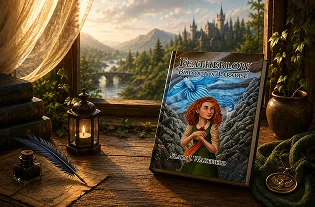
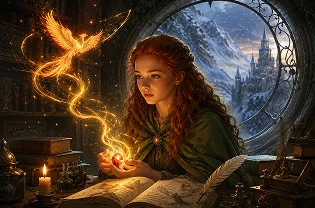
Phoenix stories often bring to mind fire, ash, death, and rebirth. Featherlow: Bird Out of Paradise keeps that wonder, but Elary J. Wakefield takes it somewhere more personal. Here, a Phoenix can be majestic one moment and small enough to shelter in a child’s hands the next. The manuscript’s author bio gives Wakefield’s full name and identifies Featherlow as her first novel.
At the center is twelve-year-old Eva Featherlow. Curious, stubborn, and tenderhearted, she wants adults to see that she is capable. In fact, Eva proudly calls herself a “big, strong twelve-year-old.” Her adventure begins when she refuses to leave an injured cardinal in the snow. That small act opens a world of Phoenixes, Sages, ancient language, war, and family secrets.
So, what makes this Phoenix fantasy feel different? The answer appears feather by feather.
First Feather: A Phoenix Fantasy That Starts With Compassion
Eva does not meet a Phoenix while chasing a prophecy or seeking power. She sees a tiny cardinal fighting for its life and chooses to help.
That cardinal becomes Alister, the Wing Bearer of Fire and Flame. When his true nature finally appears, Eva realizes the little bird she protected is a real Phoenix. His transformation is spectacular, yet their bond begins with something simple: Eva could not walk away.
Because of that, their friendship feels earned. Alister can be proud and dramatic. Eva can be impulsive. They argue, worry, joke, and keep choosing to protect each other.
As a result, the story finds warmth before the mythology becomes huge. The reader is not only watching magical creatures fight. The reader is watching trust grow under pressure.
Second Feather: Phoenixes Have More to Lose Than Their Feathers
The Phoenix mythology soon becomes much larger.
Alister belongs to a wider order of Wing Bearers. Mystral is linked to water and ice, while other Phoenixes connect to earth, souls, and Eternity. More strikingly, Phoenix hearts can be taken. Mystral steals Alister’s heart, leaving him alive but weakened.
That idea changes the usual image of the immortal firebird. These Phoenixes may be powerful, yet they can still lose something essential.
The book also links Phoenixes to Songbird Sages and magical stones. Those bonds carry duty, grief, memory, and choice. Therefore, the magic feels like part of a history rather than a list of special powers.
For readers who browse Phoenix fantasy books for elemental magic and mythical creatures, this story asks a compelling question: what does immortality mean when loss can still hurt?
Third Feather: This Phoenix Fantasy Story Speaks in Music
One of the book’s most distinctive ideas is Songbird.
Instead of appearing as normal writing, the ancient language takes shape through music notes, melody, and Phoenix magic. The novel itself describes those notes as an ancient language and calls Songbird the “melody of the Phoenixes.” Eva can understand pieces that others cannot. At times, magic even leaves her mouth as song rather than an ordinary spoken spell.
That choice fits the bird-centered world beautifully. It also gives magic a sensory quality. You can almost hear the mystery unfolding.
Songbird Stones deepen that idea. They glow, react, carry magic, and connect Sages with Phoenixes. Eva’s stone is especially unpredictable. Sometimes it answers her. Sometimes it stays cold.
So, learning magic never feels automatic. Eva remains curious, and the reader stays curious beside her.
Fourth Feather: The “Monsters” Keep Changing Shape
Another strength of this unique Phoenix fantasy story is how often first impressions fall apart.
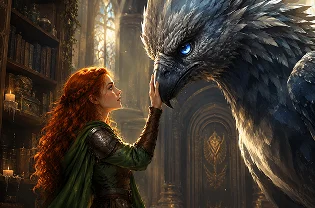
Eva has heard frightening things about Flame-Hearts. Then Flame-Hearts save her. General Skuld looks made for war, yet he can protect. Roden seems intimidating, yet he is a doctor and Sage. Lord Territh holds great power, but he also enjoys tea and beauty.
The story never pretends every creature is secretly harmless. Real danger remains. However, it keeps asking Eva to look again.
That idea is stated especially clearly through Roden. When Eva asks why people hate Flame-Hearts, he explains that people fear what they do not understand. Yet the novel does not leave that idea as a lesson. Eva has to live through it.
Umbra characters also blur the easy line between enemy and ally. Fear, loyalty, family, corruption, and duty all shape their choices.
A few ideas sit beneath the adventure:
- What we hear about someone may not be the whole truth.
- Fear can turn difference into a story about monsters.
- Kindness does not equal weakness.
- Bravery can begin before certainty does.
Because Eva learns these lessons through experience, they feel woven into the journey rather than added as lectures.
Fifth Feather: Eva Keeps the Magic Human
For all its kingdoms, ancient songs, armies, and magical stones, the story works because Eva remains emotionally familiar.
She misses her parents. She wants adults to trust her. She gets frightened, cries, jokes, makes reckless choices, apologizes, and tries again. Even when powerful magic begins answering her, she never becomes all-knowing.
That keeps the fantasy grounded.
Family gives Eva a reason to move forward, while unexpected friendships change what “safe” means to her. Just as importantly, quiet moments sit beside danger. A frightening creature may cook a meal, mend a wound, carry a tired child, or offer warmth in the cold.
Those moments give the adventure room to breathe.
Last Feather: Why Featherlow Feels Like Its Own World
By the time the wider conflict emerges, the story has built many layers: elemental Phoenixes, stolen hearts, Songbird Stones, musical language, hidden Sages, rival peoples, and an old struggle tied to Eternity.
Who deserves our trust?
Elary J. Wakefield does not make Eva’s age or small size something she must outgrow before she matters. Instead, her curiosity and compassion repeatedly move the story forward.
That is what gives Featherlow: Bird Out of Paradise its own identity. It offers battles, transformations, old magic, and Phoenix lore. At the same time, it keeps humor, family love, tenderness, and unlikely friendship close to the center.
For a Phoenix fantasy story, that balance feels fresh. The book opens a world of fire and ice, then gently suggests that powerful magic can begin with one small choice: refusing to walk away.